
Physics - Vertical Motion (*pause*)
OPENING QUESTION: Let's imagine that we are standing on top of a building and we throw an object directly upward, right at the side of the building.
What is important about that description?
Sketch that situation.
What are the critical parts of the motion of that object as it goes up and then comes down? (Please label those on your sketch)
Why DO we consider the velocity of the object (vf) the tiniest fraction of a second before it hits the ground and NOT the tiniest fraction of a second after it hits the ground?
LEARNING OBJECTIVES:
- I will evaluate my algebra/isolating variables skills during today's class
CALENDAR:
WORDS O' THE DAY:
- gravity! gravity! gravity!
FORMULAE OBJECTUS:
-
a = (vf - vi)/(tf - ti) (definition of acceleration)
- g = 9.81 m/s2 (acceleration an object experience on Earth) ONLY present in vertical motion (Y axis) problems
1) vfy = viy +agt
2) yf = yi + viyt + 1/2agt2
3) vfy2 - viy2 = 2ag∆y
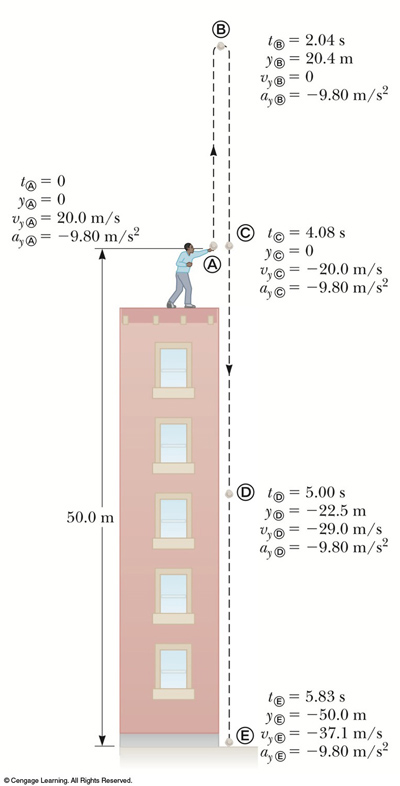
Let's go back to this MOST informative (AND COMPLEX) graphic of a falling object problem:
 |
There are a couple of things to keep in mind when we evaluate motion in 1 dim (vertically):
Here's a pretty complex graphic. Look at JUST parts A and B. What can you determine from the values shown there? |
Let's take a look at a couple of practice problems in our book: #40, 42 and 43.